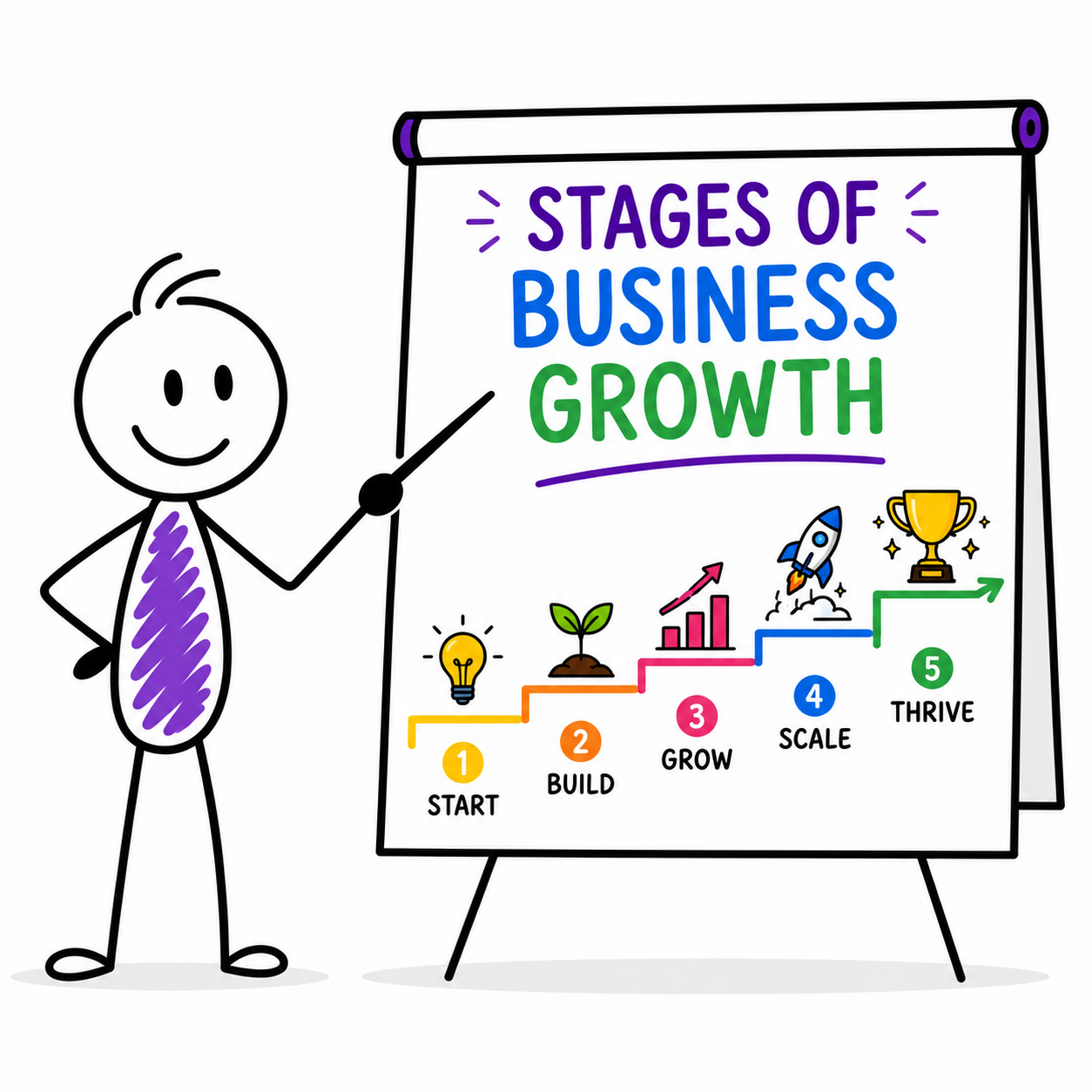
Your business doesn't need the same thing at every stage.
What helps a business go from $0 to its first customer is very different from what helps it go from $1M to $10M.
That's one of the biggest ideas behind Alex Hormozi's $100M Scaling Roadmap. The roadmap breaks business growth into 10 distinct stages, with each stage having a different problem to solve.
You can actually hurt your business by solving the wrong problem too early.
So let me make it simple for you. Click through the interactive roadmap below to explore each stage:
The Full 10-Stage Breakdown
🟢 Stage 0 — Improvise
You're starting from an idea. You don't really have a business yet. You're testing things, figuring out what people want, and trying to get someone to use what you're offering.
“Can I get someone to want this?”
Don't worry about building a huge company yet. Get something people actually want.
🟢 Stage 1 — Monetize
You have something people want. Now you need to prove that people will actually pay for it. Your focus becomes: Turn interest → into money.
“Can I consistently get people to pay me?”
🟢 Stage 2 — Advertise
Now you know people will pay. The next challenge is getting more of the right people to notice you. You need a predictable way to generate attention and leads.
“Can I consistently get potential customers?”
🟡 Stage 3 — Stabilize
You're getting customers and making money. But things may still feel chaotic. You need to make the business more consistent and predictable.
“Can I make this work consistently?”
🟡 Stage 4 — Prioritize
The business is growing. Now there are more problems, more opportunities, and more things demanding your attention. You can't do everything.
“What's the biggest thing holding us back?”
🟠 Stage 5 — Productize
Your business is becoming bigger. You can't rely on reinventing everything every time a customer comes in. You need repeatable offers, processes, and ways of delivering value.
“How can we make this repeatable?”
🟠 Stage 6 — Optimize
Now you have something that works. It's time to make it work better. Improve your Sales, Marketing, Operations, Team, Profitability, and Customer experience.
“How can we get better results from what we already have?”
🔵 Stage 7 — Categorize
The business has become much larger. You now have different areas, teams, products, customers, and responsibilities. Things need to become more organized.
“How do we organize this complexity?”
🔵 Stage 8 — Specialize
At this level, specialization becomes increasingly important. Instead of everyone trying to do everything, people and teams can become responsible for specific functions.
“Who should own each part of the business?”
🟣 Stage 9 — Capitalize
Now you're operating at a very large scale. The focus shifts toward using the strength of the business to create even more value. Capital, leadership, systems, and strategic decisions become crucial.
“How do we turn what we've built into something even more valuable?”
Here's the Big Lesson
Look at the progression:
The important thing isn't memorizing all ten stages. It's understanding this:
- • If you're struggling to get your first customers, you probably don't need a complicated organizational structure.
- • If you're getting customers but can't deliver consistently, you probably don't need to spend all your energy finding even more customers.
- • If you're already growing quickly, your biggest challenge might be completely different.
So Where Are You?
Ask yourself:
What is the biggest problem preventing my business from reaching the next level?
Not ten problems. ONE.
Find it. Fix it. Then find the next one.
Don't build for the business you hope to have.